Sunday, July 4, 2010

POST #7: Continued.

Soldiers patroling the Cave of the Patriarchs. The soldier facing the camera is enjoying some snacks, sponsored by Chabad of Calabasas. You feel such a debt of gratitude to these kids...you don't know what to do, just saying thanks don't cut it. He was buying snacks when we were, so we footed the bill. Big deal. But you gotta do something.

The steps up to the Cave. This structure was completed by Herod.

The lady in the bottom right of the picture is Davening at the closest possible spot to the actual cave where Adam, Chavah, Avraham, Sarah, Yitzchak, Rivkah, Yaakov and Leah are buried. She is also at the only spot where Jews were permitted to stand prior to the 67 War. There were steps there that were available for the Jews to stand on, and when the Israeli soldiers took over Chevron in the war they destroyed the hated symbol of the Arabs' denigration of the Jews.

Our guide was so interesting. He even found interesting places to keep is Coke.

Shainy and Malka in a moment of quiet reflection inside the onsite Shul.

POST #7: Continued.

I did it again. OK.

1. As soon as you pass that checkpoint, you see the separation wall. Here is the first part of the wall.

2. Then it changes to this style.

3. This settlement is called "Elazar" after Judah Maccabbee's brother Elazar, who was killed during the war with the Greeks. He killed a war elephant that crushed him when it fell. This war (the Chanukah story) took place in this area.

4. As we traveled down the winding roads of the Arab section of Hebron, we saw the residences that were never rebuilt by the Arabs following the Six Day War. You can see scrawlings on the war, different colors from different terrorist groups.

5. Another ruin. I am not sure whether or not people live in these ruins.


POST #7: Chevron and Beit Lechem

Today we joined a guided tour of Hebron and Beit Lechem, the sites of the Cave of the Patriarches (Mearas Hamachpela) and Rachel's Tomb (Kever Rachel.) I messed up with formatting this post si here is a description of each picture, in order.

1. On the way out of Jerusalem, we stopped here. This is the view from the plaza of the UN in Jerusalem. You can see the walls of the Old City and the Kotel area in the center of the area.

This is where they imagine Avraham and Yitzchak first beheld the mountain when they were coming to perform the Akeidah, the binding of Isaac. (Based in where they were coming from, and the fact that the Torah says that they saw the mountain on the third day...

2. Friedmans in Israel.

3. Rashi says in Chumash that just like the meat between the shoulders of an ox is the choicest, Hashem placed the Temple spot right between to high points and you can see that in this picture nicely.

4. On the busride to Hebron, we passed by this valley, where King David waged several wars against the Philistines.

5. Since Hebron is 80% in Palestinian hands, there is a checkpoint here inspecting all the vehicles coming into Jerusalem from Hebron.


POST #6: The Golan Heights

This was a profound experience. I had heard the Rebbe speak so many times about the critical value of the Golan Heights, how invaluable it is to Israel's security. Now we get to see it.

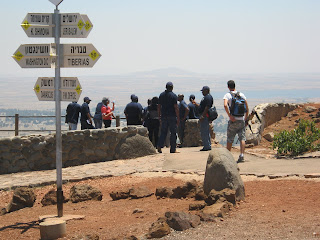
So here is the top of Mount Bental, one of the sites of the battles for the Golan Heights during the 1967 and 73 war. And a great vantage point and lookout for the whole area.
This is a view of the Kibbutz that lies in the valley, in the Golan Heights at the foot of Mt. Bental. This Kibbutz was built as soon as negotiations with Syria stalled in the aftermath of the Six Day War and was heavily bombed and damaged in the Yom Kippur War.
Rising above the horizon, you see great big Mt. Chermon, the highest point in Israel.
To the right, you can see the slopes of Mt. Avital, another mountain (Golan Height) captured by Israel in the 67 war. Beyond that you see Syria. Damascus is only 37 miles from the camera I took this picture with. In the plain, you can see the agriculture developed by Israel since the Yom Kippur War.

Right in the middle of the picture there is a small cluster of white buildings, this is the UN Peacekeeping Force, there along the border since the 1973 ceasefire.
This is same plain, valley, it is called "Valley of Tears." Here is a paragraph from JewishVirtualLibrary.com about the incredible history of this valley and area:

In the Yom Kippur War of 1973, Mount Bental was the site of one of the largest tank battles in history. Mount Bental is a key strategic point for Israel due to its advantageous observation point. Israel knew it count not risk losing this mountain, nor any of the Golan Heights . The Syrians attacked the Golan with 1,500 tanks and 1,000 artillery pieces. Israel countered with only 160 tanks and 60 artillery pieces. The long stretch of valley in between Mount Bental and Mount Hermon became known as the Valley of Tears. The 100 Israeli tanks were reduced to seven under extreme enemy fire. However, the Israelis managed to take down 600 Syrian tanks in the process. The Syrians eventually retreated, but not without inflicting heavy casualties on Israel.
A view from the back of the mountain-top fortification.
A Nigerian tour group.
Here is a better view of the Valley of Tears with Mt. Hermon towering in the background.
And after all that, and all the hostility with Syria etc., this has been one of Israel's QUIETEST borders since the end of their last major war, the Yim Kippur War.

I have a lot of video from this visit, including video of the bunkers under the fortification, but it takes forever to upload them to the internet.


Saturday, July 3, 2010

POST #5


On the road again...to Tzfat (Safed), the holy city, cradle of Kabbalah.
A view of Tzfat from where we ate with my uncle and aunt who are Shluchim (Chabad emissaries) here.
This gives you an idea of the structure of Tzvat, this is a view of the old city of Tzvat from the place we were eating at.
Photography by Aunt Leah.
This is my uncle, Rabbi Eli (Elik) Friedman, a very special man indeed, respected not just by his students but by our whole family. A unique person, though his appearance is not so unique, looks exactly like my father and the rest of his brothers.
The Tzfat mountain tops that you see here are home to one of Israel's most top-secret military bases. As my uncle put it, even the Chabadniks with the Tefillin are not allowed on to the base.

In the 2006 Lebanon war Hizbollah tried bombing this base and ended up shelling Tzfat instead.
This is a typical multi-family residence in this mountain city, Tzfat.

POST #4


Outside the Tomb of Rachel, the wife of Rabbi Akiva. She is the famous wife who sent her husband away for 24 years to learn and he became...Rabbi Akiva. On the side of the Mausoleum(out of the picture) there is an inscription with the words that he said to his students, "Mine and yours (wisdom) are hers.")

Shainy is getting some of those notorious Israeli directions to Rabbi Akiva's tomb.
This is at Rabbi Akiva. The plate reads "The Tanna (Mishnaic Sage) Rabbi Akiva ben Yosef, may his merit protect us, amen." Amazing how after 1900 years, Rabbi Akiva's presence is still so powerful and standing next to this man who was tortured and murdered by the Roman empire for his religious leadership is a major inspiration to be a better Jew.
Rabbi Akiva is buried in an incredible spot on top of Teverya. This is the Nof (view).
At the Tomb of the Rambam, Maimonides. His tomb reads "From Moshe (Moses) until Moshe (Rambam), there was no one like Moshe." (The Rambam's name was Moshe ben Maimon.)

The Rambam's tomb is by far the most impressive, with a great tower built over it and a beautiful landscaping and monuments all around with the names of the holy books he authored.
On the pillars you can see the names of the holy books.
Next to the Rambam, you find the tombs of some other incredible people. We found the Shelah http://www.chabad.org/library/article_cdo/aid/112346/jewish/Rabbi-Isaiah-Halevi-Horowitz-The-Sheloh.htm,
we found one of the greatest Talmudic Rabbis, Yochanan ben Zakkai, http://en.wikipedia.org/wiki/Yochanan_ben_Zakai,
and the Rabbis Yehoshua ben Chananya, Rabbi Yosi Hacohen, Rabbi Shimon ben Nesanel and Rabbi Elazar ben Arach.

It is an incredible thing to visit these graves after years of studying the teachings and saying of these Tzadikim and hearing the stories and anecdotes about them which make up our faith! Unbelievable.
This is at the massive tomb of Rabbi Shimon bar Yochai, in Meron (near Tzfat), the author of the Zohar and the "founder" of Kabbalah as we know it. No elaboration is necessary, except to say that it was sooo hot, that's why I look bedraggled, nothing more than that!

Friday, July 2, 2010

POST #3

The view of Teveriah and the Sea of Galilee from the tomb of Rabbi Chiya and his sons.

The Talmud relates that Elijah the prophet once revealed to Rabbi Judah the Prince that if Rabbi Chiya and his sons would pray simultaneously the Messiah would arrive. Rabbi Judah then called a public fast day and during the prayer service ordered Rabbi Chiya and his sons to lead the service. (On a fast day, three people lead the services.) When they reached the prayer of “He restores life to the dead,” an allusion to the Messianic era, the world shook. A voice was heard in heaven: “Who revealed secrets in the world?”—referring to the secret of how to bring the Messiah. And the reply was: “Elijah.”

Just an idea of who these people were.
Shainy and Malka on the steps leading up to the Tomb.
The Tomb
Pardon the untucked shirt...Teverya was very, very hot.